Abstract
Background: Eggshell membrane (ESM) is a natural biomaterial rich in collagen, elastin, glycosaminoglycans, and hyaluronic acid. These bioactive components are fundamental to skin structure and have shown potential for improving skin health when administered orally. However, clinical evidence supporting the anti-aging effects of oral ESM supplementation remains limited. Objective: To evaluate the effects of oral ESM supplementation on skin biomechanical properties, wrinkle parameters, surface roughness, and self-perceived skin quality in middle-aged women over a 90-day treatment period. Methods: A single-arm clinical study was conducted in 33 female volunteers (age: 38–66 years; mean 51.5 ± 8.2) with moderate-to-severe signs of aging. Participants received 500 mg/day of soluble ESM orally for 90 days. Skin assessments were performed at baseline (D0), Day 45 (D45), and Day 90 (D90) using 3D fringe projection analysis (AEVA-HE) for wrinkle and surface roughness parameters, and cutometry (Cutometer MPA Dual 580) for biomechanical properties. A self-assessment questionnaire was administered at each time point. Statistical analysis was performed using one-way ANOVA with Dunnett’s multiple comparisons test. Results: Oral ESM supplementation significantly improved skin distensibility (R0), with increases of 6.8% at D45 (p < 0.05) and 9.6% at D90 (p < 0.05) compared to baseline. Wrinkle parameters and surface roughness remained stable throughout the treatment period, with no statistically significant deterioration. Self-perception assessments revealed that 75.8% of participants reported smoother expression lines, 66.7% perceived improved hydration, and 60.6% noted enhanced firmness and elasticity at D90. The treatment demonstrated excellent skin compatibility with no serious adverse effects. Conclusions: Daily oral supplementation with 500 mg of soluble ESM for 90 days significantly improved skin distensibility and was associated with favorable self-perceived improvements in multiple skin quality parameters. These findings support the potential of oral ESM as a well-tolerated nutraceutical approach for skin health maintenance in aging women.
Keywords
Eggshell Membrane, Oral Supplementation, Skin Aging, Cutometry, Skin Distensibility, Wrinkles, Nutraceutical,
Clinical Study
1. Introduction
Skin aging is a complex biological process influenced by both intrinsic factors, such as genetic predisposition and hormonal changes, and extrinsic factors including ultraviolet radiation, environmental pollution, and lifestyle habits
| [1] | Boismal, F., Serror, K., Dobos, G., Zuelgaray, E., Bernausson, A., Michel, L. Vieillissement cutané: Physiopathologie et thérapies innovantes, médecine/sciences. 2020, 36(12), 1163–1172. https://doi.org/10.1051/medsci/2020232 |
| [2] | Rattanawiwatpong, P., Wanitphakdeedecha, R., Bumrungpert, A., Maiprasert, M. Anti-aging and brightening effects of a topical treatment containing vitamin C, vitamin E, and raspberry leaf cell culture extract: A split-face, randomized controlled trial, Journal of Cosmetic Dermatology. 2020, 19(3), 671–676. https://doi.org/10.1111/jocd.13305 |
| [3] | Farage, M. A., Miller, K. W., Elsner, P., Maibach, H. I. Intrinsic and extrinsic factors in skin ageing: a review, International Journal of Cosmetic Science. 2008, 30(2), 87–95.
https://doi.org/10.1111/j.1468-2494.2007.00415.x |
[1-3]
. The visible manifestations of skin aging, including wrinkles, loss of elasticity, decreased firmness, and reduced hydration, represent one of the most prevalent aesthetic concerns worldwide, significantly impacting self-esteem and quality of life
| [4] | Zeng, J., Bo, B., Chen, L., Yang, P., Guo, Y., Zhou, Y., Liu, T. Repeated exposure of mouse dermal fibroblasts at a sub-cytotoxic dose of UVB leads to premature senescence: A robust model of cellular photoaging, Journal of Dermatological Science. 2014, 73(1), 49–56.
https://doi.org/10.1016/j.jdermsci.2013.08.013 |
[4]
.
The structural integrity of the skin depends primarily on the dermis, where collagen and elastin form a three-dimensional scaffold that confers mechanical resistance and elasticity. Glycosaminoglycans (GAGs), particularly hyaluronic acid (HA), play a critical role in maintaining hydration and firmness of the extracellular matrix (ECM)
| [5] | Lee, S. H., Seo, H. S., Seo, S. J., Kim, C. D., Hong, S. P. Screening of Plant-Derived Natural Extracts to Identify a Candidate Extract Capable of Enhancing Lipid Synthesis in Keratinocytes, Annals of Dermatology. 2022, 34(5), 331–339.
https://doi.org/10.5021/ad.21.288 |
[5]
. With advancing age, the synthesis of these key components progressively declines: collagen production decreases by approximately 1% per year after the age of 30, while HA content in the skin of a 75-year-old individual is less than one-quarter of that found in young subjects
| [6] | Genovese, L., Corbo, A., Sibilla, S. An Insight into the Changes in Skin Texture and Properties following Dietary Intervention with a Nutricosmeceutical Containing a Blend of Collagen Bioactive Peptides and Antioxidants, Skin Pharmacology and Physiology. 2017, 30(3), 146–158.
https://doi.org/10.1159/000464470 |
[6]
.
In recent years, the nutraceutical approach to skin health has gained considerable attention, with oral supplementation of bioactive compounds emerging as a complementary strategy to topical treatments
. Among the most promising natural biomaterials is eggshell membrane (ESM), a thin proteinaceous layer located between the eggshell and the albumen. ESM contains a unique natural combination of collagen (types I, V, and X), elastin, glycosaminoglycans (including dermatan sulfate and chondroitin sulfate), and hyaluronic acid—the same components essential for maintaining skin structure and function
| [8] | Ruff, K. J., DeVore, D. P., Leu, M. D., Robinson, M. A. Eggshell membrane: A possible new natural therapeutic for joint and connective tissue disorders. Results from two open-label human clinical studies, Clinical Interventions in Aging. 2009, 4, 235–240.
https://doi.org/10.2147/CIA.S5797 |
| [9] | Shi, Y., Kovacs-Nolan, J., Jiang, B., Tsao, R., Mine, Y. Antioxidant activity of enzymatic hydrolysates from eggshell membrane proteins and its protective capacity in human intestinal epithelial Caco-2 cells, Journal of Functional Foods. 2014, 10, 35–45. https://doi.org/10.1016/j.jff.2014.05.004 |
[8, 9]
.
Previous studies have demonstrated that supplementation with ESM hydrolysate can improve joint comfort and reduce stiffness, attributed to its anti-inflammatory and connective tissue-supporting properties
| [10] | Ruff, K. J., Winkler, A., Jackson, R. W., DeVore, D. P., Ritz, B. W. Eggshell membrane in the treatment of pain and stiffness from osteoarthritis of the knee: a randomized, multicenter, double-blind, placebo-controlled clinical study, Clinical Rheumatology. 2009, 28(8), 907–914.
https://doi.org/10.1007/s10067-009-1173-4 |
[10]
. In the European Union, ESM has been approved under Novel Food regulations by the European Food Safety Authority (EFSA) and is authorized for use as an ingredient in food supplements at a typical dose of 450–500 mg/day for adults
| [11] | Commission Implementing Regulation (EU) 2018/1647 of 31 October 2018 authorising the placing on the market of egg membrane hydrolysate as a novel food under Regulation (EU) 2015/2283, Official Journal of the European Union. 2018, L 274, 51–55. |
[11]
. However, clinical evidence specifically addressing the dermatological effects of oral ESM supplementation remains limited.
The aim of the present study was to evaluate the effects of daily oral supplementation with 500 mg of soluble ESM on skin biomechanical properties, wrinkle parameters, surface roughness, and self-perceived skin quality in a panel of 33 middle-aged women with moderate-to-severe signs of aging, over a 90-day treatment period.
2. Materials and Methods
2.1. Study Design and Ethics
An open-label, single-center clinical study was conducted at Dermaclaim Lab S. L. (Valencia, Spain). The clinical protocol was approved by the Research Ethics Committee for Medicinal Products (CEIm) of Hospital La Fe (Valencia, Spain) on September 24, 2025. The study was conducted in accordance with the Declaration of Helsinki (as amended through 2024), the International Conference on Harmonisation Good Clinical Practice guidelines (ICH-GCP), and the Scientific Committee on Consumer Safety (SCCS) guidelines. All participants provided written informed consent prior to enrollment.
2.2. Study Population
Thirty-six volunteers were initially recruited. Three participants were excluded: two prior to study initiation (one due to scheduling conflicts and another reassigned to a different study) and one who voluntarily withdrew after one day of treatment. The final study population consisted of 33 participants who completed all assessments. Inclusion criteria required female sex, age between 35 and 65 years, and moderate-to-very-severe signs of aging (grades 2–4 on the Eiben-Nielson photonumeric scale for wrinkles and loss of elasticity)
| [12] | Eiben-Nielson, C., Kerscher, M. Development and validation of a global photonumeric scale for evaluating skin quality of aged female facial skin, Journal of Cosmetic Dermatology. 2021, 20(1), 1–8. https://doi.org/10.1111/jocd.14058 |
[12]
. Exclusion criteria included relevant dermatological, systemic, or gastrointestinal diseases, aesthetic treatments within the previous 6 months, pregnancy or lactation, and known allergy to egg-derived products.
Panel characteristics are summarized in
Table 1.
Table 1. Demographic and baseline characteristics of the study population (N = 33).
Parameter | Value |
Number of participants | 33 |
Sex | Female: 33 (100%) |
Age range (Mean ± SD) | 38–66 (51.5 ± 8.2) years |
Ethnicity | Caucasian: 33 (100%) |
Skin phototype (Fitzpatrick) | II: 17 (51.5%) | III: 16 (48.5%) |
Dropout rate | 3/36 (8.3%) |
2.3. Test Product and Administration
The test product was ESM Eggshell Membrane Soluble (Torolis Explotaciones S. L., Navarra, Spain), presented in individual sachets containing 500 mg of soluble eggshell membrane powder. Participants were instructed to dissolve one sachet daily in water and consume it orally for 90 consecutive days. The product is marketed in the European Union in compliance with EU Novel Food regulations
| [11] | Commission Implementing Regulation (EU) 2018/1647 of 31 October 2018 authorising the placing on the market of egg membrane hydrolysate as a novel food under Regulation (EU) 2015/2283, Official Journal of the European Union. 2018, L 274, 51–55. |
[11]
.
2.4. Clinical Assessments
Assessments were performed at three time points: baseline (D0), after 45 days of treatment (D45), and after 90 days of treatment (D90). Upon arrival at the clinical facilities, participants underwent a 15-minute acclimatization period under controlled environmental conditions (23 ± 1°C; 45 ± 10% relative humidity).
2.4.1. 3D Fringe Projection Analysis
Periorbital wrinkles (crow’s feet), forehead wrinkles, and cheek surface roughness were assessed by 3D fringe projection image analysis using the AEVA-HE V4 system (FoV, Small). Parameters evaluated included wrinkle area (mm²), number, perimeter (mm), depth (mm), and volume (mm³) for wrinkle analysis, and Stm, St, Sa, Sr, and Sq parameters for surface roughness evaluation.
2.4.2. Cutometry
Skin biomechanical properties were assessed on the cheek using the Cutometer MPA Dual 580 (Courage + Khazaka electronic GmbH, Germany). The following parameters were recorded: distensibility (R0, the maximum amplitude of skin deformation under negative pressure, reflecting dermal matrix flexibility and overall skin extensibility), firmness (1/R0, the inverse of distensibility, representing resistance to mechanical deformation), gross elasticity (R2, the ratio of elastic recovery to total deformation [Ua/Uf], indicating the overall ability of the skin to return to its original position), net elasticity (R7, the ratio of immediate elastic recovery to immediate distension [Ur/Ue], reflecting the purely elastic component of the skin independent of viscous deformation), and biological fatigue (R9, the residual deformation after repeated suction cycles [R3 at the last cycle], representing the skin's susceptibility to mechanical fatigue and loss of resilience upon repetitive stress). Each measurement was performed five times per participant and time point.
2.4.3. High-resolution Photography
High-resolution macroscopic photographs were obtained using a Nikon D5600 camera mounted on a HeadScan Bench Light Face system with standardized photographic configuration and CameraScan software for image acquisition, including a professional reference colorimetric chart.
2.4.4. Self-assessment Questionnaire
Participants’ subjective perception of product efficacy was assessed using a structured questionnaire comprising 21 items distributed across three domains: sensory experience (items 1–6), treatment efficacy and self-confidence (items 7–18), and consumer behavior (items 19–21). Responses were scored on a 4-point Likert scale (1 = strongly disagree; 4 = strongly agree). Satisfaction rates were calculated as the percentage of respondents selecting scores of 3 or 4.
2.5. Statistical Analysis
Sample size was calculated using GRANMO software (Version 8.0, REGICOR, IMIM, Barcelona). Accepting an alpha risk of 0.05 and a statistical power of 0.80 (beta risk of 0.20) in a two-sided test, a minimum of 33 subjects was required to detect a difference of 5% or greater, assuming a standard deviation of 10% and a dropout rate of 5%. Individual participant data at D45 and D90 were normalized to their corresponding baseline values (D0). Statistical analysis was performed using one-way ANOVA with Dunnett’s multiple comparisons post hoc test. Self-perception data were analyzed using the Sign and Binomial test. The level of statistical significance was set at p < 0.05.
3. Results
3.1. Study Completion and Safety
Of the 36 volunteers initially recruited, 33 completed the full 90-day protocol. No serious adverse events (SAEs) were reported. One participant withdrew after one day due to palatability issues (gag reflex), classified as a non-treatment-related adverse event (AE) given the minimal exposure time. No undesirable effects (UEs) or skin discomfort were reported during the treatment period or during the subsequent 5-day follow-up, confirming excellent skin compatibility.
3.2. Skin Biomechanical Properties
Cutometric evaluation revealed significant improvements in skin distensibility (R0) following ESM supplementation. R0 increased by 6.8% at D45 and 9.6% at D90 compared to baseline (p < 0.05 for both time points), indicating progressive and statistically significant improvement in skin flexibility throughout the treatment period (
Table 2). This finding suggests that oral ESM supplementation promotes favorable changes in the viscoelastic behavior of the skin.
Gross elasticity (R2) remained stable throughout the study, with no statistically significant changes at D45 or D90, indicating preservation of the skin’s elastic recovery capacity. Net elasticity (R7) showed a transient reduction of 5.1% at D45 (p < 0.05) that largely recovered by D90 (−2.3%, not statistically significant). This transient decrease may reflect an initial adaptive response associated with active dermal extracellular matrix remodeling, during which the turnover of structural components such as collagen and elastin fibers temporarily alters the purely elastic behavior of the skin. As the reorganization of the dermal matrix progresses and newly synthesized fibers mature and become functionally integrated, net elasticity is gradually restored, consistent with the near-complete recovery observed at D90. Such biphasic responses have been described in the context of nutritional and pharmacological interventions that stimulate collagen biosynthesis, where an early remodeling phase precedes measurable improvements in tissue mechanical properties.
Biological fatigue (R9), which measures the residual deformation capacity of the skin under repeated mechanical stress, showed increases of 24.0% at D45 and 13.6% at D90 (p < 0.05), indicating enhanced skin resilience and capacity to withstand repetitive mechanical deformations without permanent structural damage.
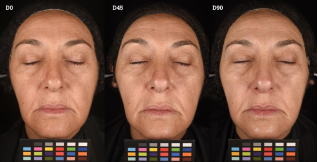
Figure 1. Overall effects on facial appearance in Volunteer A (frontal view). High-resolution macroscopic photographs obtained with Nikon D5600 + HeadScan Bench Face Light with professional reference colorimetric chart and CameraScan software, at baseline (D0), Day 45 (D45), and Day 90 (D90) of ESM treatment.
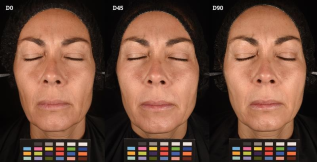
Figure 2. Overall effects on facial appearance in Volunteer B (frontal view). High-resolution macroscopic photographs obtained under the same standardized conditions, at baseline (D0), Day 45 (D45), and Day 90 (D90) of ESM treatment.
Table 2. Skin biomechanical properties assessed by cutometry at baseline (D0), Day 45 (D45), and Day 90 (D90). Values represent mean percentage change from D0 (± SEM).
Parameter | D0 (%) | D45 (%) | D90 (%) |
Distensibility (R0) | 100.0 | 106.8 ± 2.1* | 109.6 ± 2.3* |
Firmness (1/R0) | 100.0 | 93.4 ± 1.9* | 90.9 ± 2.0* |
Elasticity (R2) | 100.0 | 100.2 ± 1.5 | 100.8 ± 1.8 |
Net elasticity (R7) | 100.0 | 94.9 ± 1.6* | 97.7 ± 1.8 |
Biological fatigue (R9) | 100.0 | 124.0 ± 5.2* | 113.6 ± 4.1* |
3.3. Wrinkle Parameters
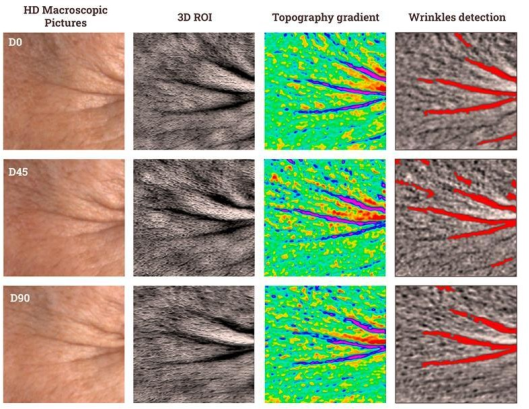
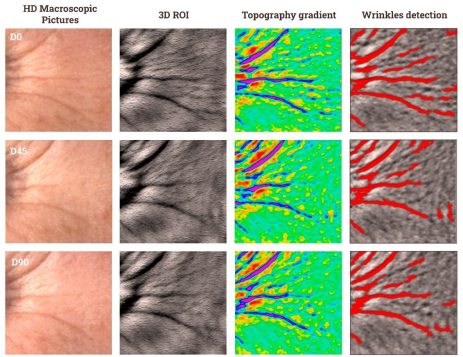
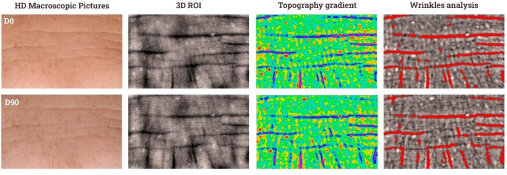
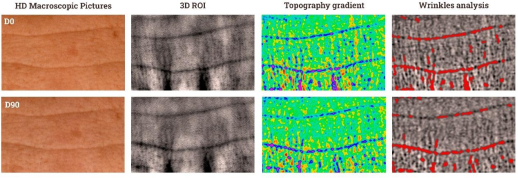
Three-dimensional analysis of periorbital wrinkles (crow’s feet) showed that all evaluated parameters remained stable throughout the 90-day treatment period (
Table 3). No statistically significant changes were observed in wrinkle area, number, perimeter, depth, or volume at D45 or D90 relative to baseline. These findings indicate that oral ESM treatment effectively maintained the wrinkle profile without deterioration over the study period, which is noteworthy considering the natural progression of wrinkle worsening associated with aging over a 3-month period.
Similarly, forehead wrinkle parameters showed no statistically significant changes following treatment (
Table 3). The stability of wrinkle dimensions across all measured parameters suggests a potential protective effect against further wrinkle progression during the supplementation period.
Table 3. Variation in wrinkle parameters relative to baseline (D0), assessed by 3D fringe projection analysis.
Parameter | Region | D0 (mean ± SD) | Δ D45 (%) | Δ D90 (%) |
Area (mm²) | Crow's feet | 27.21 ± 17.62 | +6.3 | +6.2 |
Number | Crow's feet | 9.88 ± 4.49 | +4.0 | +5.7 |
Perimeter (mm) | Crow's feet | 143.10 ± 80.03 | +6.0 | +6.2 |
Depth (mm) | Crow's feet | 0.052 ± 0.012 | +3.2 | +3.2 |
Volume (mm³) | Crow's feet | 1.62 ± 1.07 | +7.8 | +10.0 |
Area (mm²) | Forehead | 170.54 ± 67.55 | +0.3 | +4.1 |
Perimeter (mm) | Forehead | 674.92 ± 206.59 | +0.7 | +3.6 |
Depth (mm) | Forehead | 0.031 ± 0.007 | -0.5 | +1.5 |
Volume (mm³) | Forehead | 6.07 ± 3.04 | +0.1 | +3.3 |
D0 values are expressed as mean ± SD (n = 33). Δ% values represent mean percentage variation relative to baseline. No statistically significant differences were observed for any parameter (p > 0.05; one-way ANOVA with Dunnett's multiple comparisons test).
Figure 3. Periorbital wrinkle (crow’s feet) analysis in Volunteer A (right side). From left to right: high-resolution macroscopic photograph of the region of interest (ROI), 3D reconstruction of the ROI, 3D wrinkle extraction colored by topographic gradient, and wrinkle detection by depth threshold; at baseline (D0), Day 45 (D45), and Day 90 (D90) of ESM treatment.
Figure 4. Periorbital wrinkle (crow’s feet) analysis in Volunteer B (left side). From left to right: HD macroscopic photograph, 3D reconstruction, topographic gradient, and wrinkle detection; at baseline (D0), Day 45 (D45), and Day 90 (D90) of ESM treatment.
Figure 5. Forehead wrinkle analysis in Volunteer A (frontal view). From left to right: HD macroscopic photograph of the ROI, 3D reconstruction, topographic gradient, and wrinkle analysis; at baseline (D0) and Day 90 (D90) of ESM treatment.
Figure 6. Forehead wrinkle analysis in Volunteer B (frontal view). From left to right: HD macroscopic photograph, 3D reconstruction, topographic gradient, and wrinkle analysis; at baseline (D0) and Day 90 (D90) of ESM treatment.
3.4. Surface Roughness
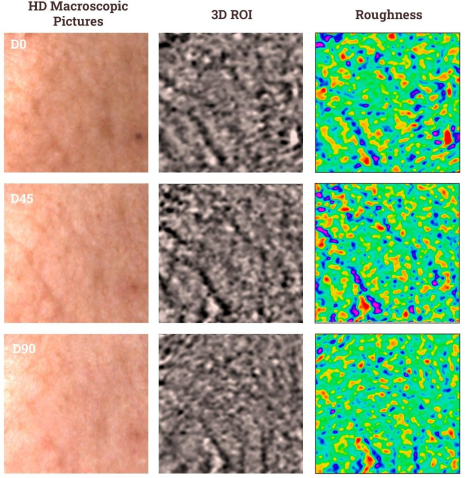
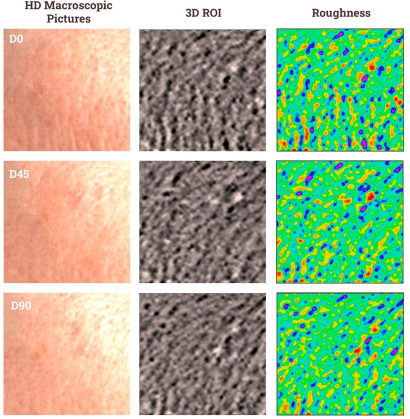
Cheek surface roughness parameters assessed by 3D fringe projection showed overall stability throughout the treatment period (
Table 4). All five roughness parameters (Stm, St, Sa, Sr, Sq) exhibited minimal non-significant variations within a narrow range of 0.03–4.5% relative to baseline values. These results demonstrate that oral ESM supplementation maintained skin surface texture characteristics without deterioration over 90 days.
Figure 7. Cheek surface roughness analysis in Volunteer A (left side). From left to right: HD macroscopic photograph of the region of interest, 3D reconstruction, and roughness map colored by depth gradient; at baseline (D0), Day 45 (D45), and Day 90 (D90) of ESM treatment.
Table 4. Surface roughness parameters assessed by 3D fringe projection. Values represent mean percentage change from baseline (D0).
Parameter | D0 (mean ± SD) | Δ D45 (%) | Δ D90 (%) |
Stm (mm) | 0.1107 ± 0.0179 | +1.5 | +1.5 |
St (mm) | 0.2050 ± 0.0595 | +3.6 | +4.5 |
Sa (mm) | 0.0137 ± 0.0024 | +1.7 | +2.6 |
Sr (ratio) | 1.0032 ± 0.0009 | +0.05 | +0.03 |
Sq (mm) | 0.0182 ± 0.0034 | +1.6 | +3.0 |
D0 values are expressed as mean ± SD (n = 33). Δ% values represent mean percentage change relative to baseline. No statistically significant differences were observed at any time point (p > 0.05).
Figure 8. Cheek surface roughness analysis in Volunteer B (right side). From left to right: HD macroscopic photograph, 3D reconstruction, and roughness map; at baseline (D0), Day 45 (D45), and Day 90 (D90) of ESM treatment.
3.5. Self-perceived Skin Quality
The self-assessment questionnaire revealed predominantly positive participant perceptions regarding the effects of treatment on skin quality (
Table 5). Overall treatment acceptance reached 49.8% at D90, increasing from 45.5% at D45, indicating a progressive positive trend in participant satisfaction.
Notably, the highest satisfaction rates at D90 were observed in the treatment efficacy domain. Smoothing of expression lines was reported by 75.8% of participants (25/33), representing the most valued perceived benefit and reaching statistical significance according to the Sign and Binomial test. Improvement in skin hydration was perceived by 66.7% (22/33) of participants. Enhancement of firmness and elasticity was reported by 60.6% (20/33), respectively. Additionally, 57.6% of participants perceived their skin as appearing younger and more radiant, and 54.5% reported less visible facial pores.
Table 5. Self-perceived skin quality at D90. Satisfaction (%) represents the proportion of participants scoring 3 (agree) or 4 (strongly agree).
Self-Assessment Item (D90) | Satisfaction (%) |
My expression lines are smoother | 75.8* |
My skin is more hydrated | 66.7 |
My crow’s feet/forehead wrinkles appear less visible | 60.6 † |
My skin feels firmer | 60.6 |
My skin feels more elastic (flexible) | 60.6 |
My skin looks younger | 57.6 |
My skin appears more radiant | 57.6 |
The treatment brightens my skin | 57.6 |
My facial pores are less visible | 54.5 |
I am satisfied with the tested treatment | 51.5 |
Provides skin tone homogeneity | 48.5 |
I would recommend the treatment | 45.5 |
Reduces the appearance of dark spots | 42.4 |
I would use the treatment again | 36.4 |
Reduces the appearance of dark circles | 30.3 |
†Although 60.6% of participants perceived reduced wrinkle visibility, this rate did not reach statistical significance. This subjective outcome is consistent with the instrumental findings, where 3D fringe projection analysis showed no statistically significant changes in wrinkle parameters (area, depth, perimeter, and volume) at D90 (
Table 3), indicating that the perceived improvement likely reflects a subtle cosmetic impression rather than a measurable structural change in wrinkle morphology.
3.6. Tolerability and Safety
The oral ESM supplement demonstrated excellent skin compatibility and safety throughout the 90-day treatment period. No serious undesirable effects (SUEs) were reported. No participant experienced skin discomfort or undesirable effects (UEs) during treatment or the subsequent follow-up period. These results support the claims of “Dermatologically tested,” “Clinically tested,” and “Tolerance tested.”
4. Discussion
The present study demonstrates that daily oral supplementation with 500 mg of soluble eggshell membrane for 90 days produces measurable improvements in skin biomechanical properties and favorable self-perceived changes in multiple skin quality parameters in middle-aged women with moderate-to-severe signs of aging.
The most notable instrumental finding was the significant and progressive increase in skin distensibility (R0), reaching 9.6% at D90. Skin distensibility reflects the capacity of the skin to deform under mechanical stress, a property largely governed by the collagen and elastin fiber network in the dermis
. The observed increase in distensibility suggests that oral ESM supplementation may promote favorable remodeling of the dermal extracellular matrix, potentially through the supply of bioactive peptides and glycosaminoglycans that serve as precursors for ECM components
| [14] | Ohara, H., Ichikawa, S., Matsumoto, H., Akiyama, M., Fujimoto, N., Kobayashi, T., Tajima, S. Collagen-derived dipeptide, proline-hydroxyproline, stimulates cell proliferation and hyaluronic acid synthesis in cultured human dermal fibroblasts, Journal of Dermatology. 2010, 37(4), 330–338.
https://doi.org/10.1111/j.1346-8138.2010.00827.x |
[14]
. The progressive nature of this improvement—from 6.8% at D45 to 9.6% at D90—supports a cumulative biological effect consistent with gradual connective tissue remodeling.
The inverse parameter, firmness (1/R0), showed a corresponding significant reduction, which is the mathematical reciprocal of the distensibility increase. Rather than indicating a loss of structural integrity, this finding reflects enhanced skin flexibility and suppleness, desirable attributes in aging skin that tends toward increased rigidity and decreased flexibility
. The preservation of gross elasticity (R2) throughout the study provides additional assurance that the skin’s elastic recovery capacity was maintained, indicating that the structural and functional integrity of the elastic fiber network was not compromised.
The increase in biological fatigue (R9) observed at both time points warrants particular attention. R9 measures residual deformation after repeated cycles of mechanical stress, and its increase indicates that the skin can undergo repeated deformations while maintaining its recovery capacity
| [16] | Krueger, N., Luebberding, S., Oltmer, M., Streker, M., Kerscher, M. Age-related changes in skin mechanical properties: a quantitative evaluation of 120 female subjects, Skin Research and Technology. 2011, 17(2), 141–148.
https://doi.org/10.1111/j.1600-0846.2010.00486.x |
[16]
. This enhanced mechanical resilience could translate into improved resistance against the repetitive facial movements that contribute to dynamic wrinkle formation over time.
Regarding wrinkle parameters, neither crow’s feet nor forehead wrinkles showed statistically significant changes over the 90-day study. Although some studies using topical anti-aging treatments have reported wrinkle reductions within similar timeframes
, the oral route of administration presents a fundamentally different pharmacokinetic profile, requiring systemic absorption, distribution, and incorporation into dermal structures. The stability of wrinkle parameters—in the context of a population with moderate-to-severe baseline aging—may be interpreted as a maintenance effect, particularly relevant considering that untreated aging skin typically exhibits progressive wrinkle deepening over time
| [18] | Trojahn, C., Dobos, G., Lichterfeld, A., Blume-Peytavi, U., Kottner, J. Characterizing Facial Skin Aging in Humans: Disentangling Extrinsic from Intrinsic Biological Phenomena, BioMed Research International. 2015, 2015, 318586.
https://doi.org/10.1155/2015/318586 |
[18]
. Longer-term studies beyond 90 days may be necessary to fully capture the potential anti-wrinkle benefits of oral ESM supplementation.
Surface roughness parameters remained equally stable, reinforcing the interpretation of a maintenance and protective effect of oral ESM treatment on skin surface characteristics.
Importantly, self-perception data revealed a notable discordance between instrumental wrinkle measurements and subjective experience, with participants consistently reporting perceived improvements in skin quality that exceeded changes detected by instrumental methods. This phenomenon, commonly observed in nutraceutical trials, may reflect multifactorial improvements in skin appearance—including hydration, luminosity, and tone uniformity—that collectively enhance overall perceived skin quality without necessarily translating into measurable changes in specific wrinkle dimensions
| [19] | Yagi, M., Yonei, Y. Glycative stress and anti-aging: 13. Regulation of Glycative stress. 1. Postprandial blood glucose regulation, Glycative Stress Research. 2019, 6(3), 175–180.
https://doi.org/10.24659/gsr.6.3_175 |
[19]
. The highest satisfaction rate was observed for smoothing of expression lines (75.8%), followed by hydration improvement (66.7%) and enhanced firmness (60.6%), all consistent with the known biological properties of ESM components, particularly hyaluronic acid and collagen-derived peptides.
The excellent safety and tolerability profile demonstrated in this study is consistent with the established safety record of ESM-based supplements and supports their use as a well-tolerated nutraceutical ingredient for skin health applications
| [10] | Ruff, K. J., Winkler, A., Jackson, R. W., DeVore, D. P., Ritz, B. W. Eggshell membrane in the treatment of pain and stiffness from osteoarthritis of the knee: a randomized, multicenter, double-blind, placebo-controlled clinical study, Clinical Rheumatology. 2009, 28(8), 907–914.
https://doi.org/10.1007/s10067-009-1173-4 |
| [11] | Commission Implementing Regulation (EU) 2018/1647 of 31 October 2018 authorising the placing on the market of egg membrane hydrolysate as a novel food under Regulation (EU) 2015/2283, Official Journal of the European Union. 2018, L 274, 51–55. |
[10, 11]
.
This study has certain limitations that should be acknowledged. The open-label, single-arm design without a placebo control group precludes definitive causal attribution and may introduce expectancy bias, particularly for self-perception outcomes. The 90-day treatment duration, while sufficient to demonstrate biomechanical improvements, may not fully capture long-term effects on wrinkle parameters. Future randomized, double-blind, placebo-controlled studies with extended treatment durations and larger sample sizes are recommended to confirm and extend these findings.
5. Conclusions
Daily oral supplementation with 500 mg of soluble eggshell membrane for 90 days significantly improved skin distensibility in a panel of 33 middle-aged women with moderate-to-severe signs of aging, with progressive improvement reaching 9.6% at Day 90. Wrinkle parameters and surface roughness were maintained throughout the treatment period, and self-perception assessments revealed high satisfaction rates for multiple skin quality attributes, particularly smoothing of expression lines (75.8%), hydration (66.7%), and firmness and elasticity (60.6%). The treatment demonstrated an excellent safety profile with no serious adverse effects. These findings support the potential of oral ESM as a well-tolerated nutraceutical approach for improving skin biomechanical properties and self-perceived skin quality in aging women. Additional placebo-controlled studies are recommended to validate these results. Future research should also explore the underlying mechanisms by which ESM bioactive components modulate dermal extracellular matrix remodeling, evaluate dose–response relationships and longer supplementation periods to determine optimal regimens, and investigate potential synergistic effects when ESM is combined with other nutraceutical or topical interventions. Furthermore, studies including diverse populations across different age ranges, skin types, and phototypes would help establish the broader applicability of oral ESM supplementation for skin health.
Abbreviations
ESM | Eggshell Membrane |
ECM | Extracellular Matrix |
GAG | Glycosaminoglycans |
HA | Hyaluronic Acid |
ANOVA | Analysis of Variance |
SEM | Standard Error of the Mean |
D0 | Day 0 (Baseline) |
D45 | Day 45 |
D90 | Day 90 |
SAE | Serious Adverse Event |
AE | Adverse Event |
UE | Undesirable Effect |
SUE | Serious Undesirable Effect |
CEIm | Research Ethics Committee for Medicinal Products |
EFSA | European Food Safety Authority |
ICH-GCP | International Conference on Harmonisation Good Clinical Practice |
SCCS | Scientific Committee on Consumer Safety |
Author Contributions
Javier Moran: Conceptualization, Data curation, Formal Analysis, Funding acquisition, Methodology, Project administration, Resources, Supervision, Validation, Writing – original draft, Writing – review & editing
Acknowledgments
The authors sincerely thank the volunteers who participated in this study and the clinical staff at Dermaclaim Lab S. L. for their technical assistance in conducting the assessments.
Data Availability Statement
The data supporting the findings of this study are available from the corresponding author upon reasonable request.
Funding
This work was funded by Torolis Explotaciones S. L.
Conflicts of Interest
The author declares no conflicts of interest.
References
| [1] |
Boismal, F., Serror, K., Dobos, G., Zuelgaray, E., Bernausson, A., Michel, L. Vieillissement cutané: Physiopathologie et thérapies innovantes, médecine/sciences. 2020, 36(12), 1163–1172.
https://doi.org/10.1051/medsci/2020232
|
| [2] |
Rattanawiwatpong, P., Wanitphakdeedecha, R., Bumrungpert, A., Maiprasert, M. Anti-aging and brightening effects of a topical treatment containing vitamin C, vitamin E, and raspberry leaf cell culture extract: A split-face, randomized controlled trial, Journal of Cosmetic Dermatology. 2020, 19(3), 671–676.
https://doi.org/10.1111/jocd.13305
|
| [3] |
Farage, M. A., Miller, K. W., Elsner, P., Maibach, H. I. Intrinsic and extrinsic factors in skin ageing: a review, International Journal of Cosmetic Science. 2008, 30(2), 87–95.
https://doi.org/10.1111/j.1468-2494.2007.00415.x
|
| [4] |
Zeng, J., Bo, B., Chen, L., Yang, P., Guo, Y., Zhou, Y., Liu, T. Repeated exposure of mouse dermal fibroblasts at a sub-cytotoxic dose of UVB leads to premature senescence: A robust model of cellular photoaging, Journal of Dermatological Science. 2014, 73(1), 49–56.
https://doi.org/10.1016/j.jdermsci.2013.08.013
|
| [5] |
Lee, S. H., Seo, H. S., Seo, S. J., Kim, C. D., Hong, S. P. Screening of Plant-Derived Natural Extracts to Identify a Candidate Extract Capable of Enhancing Lipid Synthesis in Keratinocytes, Annals of Dermatology. 2022, 34(5), 331–339.
https://doi.org/10.5021/ad.21.288
|
| [6] |
Genovese, L., Corbo, A., Sibilla, S. An Insight into the Changes in Skin Texture and Properties following Dietary Intervention with a Nutricosmeceutical Containing a Blend of Collagen Bioactive Peptides and Antioxidants, Skin Pharmacology and Physiology. 2017, 30(3), 146–158.
https://doi.org/10.1159/000464470
|
| [7] |
Honigman, R., Castle, D. J. Aging and cosmetic enhancement, Clinical Interventions in Aging. 2006, 1(2), 115–119.
https://doi.org/10.2147/ciia.2006.1.2.115
|
| [8] |
Ruff, K. J., DeVore, D. P., Leu, M. D., Robinson, M. A. Eggshell membrane: A possible new natural therapeutic for joint and connective tissue disorders. Results from two open-label human clinical studies, Clinical Interventions in Aging. 2009, 4, 235–240.
https://doi.org/10.2147/CIA.S5797
|
| [9] |
Shi, Y., Kovacs-Nolan, J., Jiang, B., Tsao, R., Mine, Y. Antioxidant activity of enzymatic hydrolysates from eggshell membrane proteins and its protective capacity in human intestinal epithelial Caco-2 cells, Journal of Functional Foods. 2014, 10, 35–45.
https://doi.org/10.1016/j.jff.2014.05.004
|
| [10] |
Ruff, K. J., Winkler, A., Jackson, R. W., DeVore, D. P., Ritz, B. W. Eggshell membrane in the treatment of pain and stiffness from osteoarthritis of the knee: a randomized, multicenter, double-blind, placebo-controlled clinical study, Clinical Rheumatology. 2009, 28(8), 907–914.
https://doi.org/10.1007/s10067-009-1173-4
|
| [11] |
Commission Implementing Regulation (EU) 2018/1647 of 31 October 2018 authorising the placing on the market of egg membrane hydrolysate as a novel food under Regulation (EU) 2015/2283, Official Journal of the European Union. 2018, L 274, 51–55.
|
| [12] |
Eiben-Nielson, C., Kerscher, M. Development and validation of a global photonumeric scale for evaluating skin quality of aged female facial skin, Journal of Cosmetic Dermatology. 2021, 20(1), 1–8.
https://doi.org/10.1111/jocd.14058
|
| [13] |
Piérard, G. E., Lapière, C. M. Microanatomy of the Dermis in Relation to Relaxed Skin Tension Lines and Langer’s Lines, The American Journal of Dermatopathology. 1987, 9(3), 219–224.
https://doi.org/10.1097/00000372-198706000-00007
|
| [14] |
Ohara, H., Ichikawa, S., Matsumoto, H., Akiyama, M., Fujimoto, N., Kobayashi, T., Tajima, S. Collagen-derived dipeptide, proline-hydroxyproline, stimulates cell proliferation and hyaluronic acid synthesis in cultured human dermal fibroblasts, Journal of Dermatology. 2010, 37(4), 330–338.
https://doi.org/10.1111/j.1346-8138.2010.00827.x
|
| [15] |
Dobrev, H. Application of Cutometer area parameters for the study of human skin fatigue, Skin Research and Technology. 2005, 11(2), 120–122.
https://doi.org/10.1111/j.1600-0846.2005.00090.x
|
| [16] |
Krueger, N., Luebberding, S., Oltmer, M., Streker, M., Kerscher, M. Age-related changes in skin mechanical properties: a quantitative evaluation of 120 female subjects, Skin Research and Technology. 2011, 17(2), 141–148.
https://doi.org/10.1111/j.1600-0846.2010.00486.x
|
| [17] |
Draelos, Z. D. Nutrition and enhancing youthful-appearing skin, Clinics in Dermatology. 2010, 28(4), 400–408.
https://doi.org/10.1016/j.clindermatol.2010.03.019
|
| [18] |
Trojahn, C., Dobos, G., Lichterfeld, A., Blume-Peytavi, U., Kottner, J. Characterizing Facial Skin Aging in Humans: Disentangling Extrinsic from Intrinsic Biological Phenomena, BioMed Research International. 2015, 2015, 318586.
https://doi.org/10.1155/2015/318586
|
| [19] |
Yagi, M., Yonei, Y. Glycative stress and anti-aging: 13. Regulation of Glycative stress. 1. Postprandial blood glucose regulation, Glycative Stress Research. 2019, 6(3), 175–180.
https://doi.org/10.24659/gsr.6.3_175
|
Cite This Article
-
APA Style
Moran, J. (2026). Oral Supplementation with Soluble Eggshell Membrane Improves Skin Biomechanical Properties and
Self-perceived Skin Quality in Middle-aged Women:
A 90-day Clinical Study. International Journal of Clinical Dermatology, 9(1), 60-71. https://doi.org/10.11648/j.ijcd.20260901.18
 Copy
|
Copy
|
 Download
ACS Style
Moran, J. Oral Supplementation with Soluble Eggshell Membrane Improves Skin Biomechanical Properties and
Self-perceived Skin Quality in Middle-aged Women:
A 90-day Clinical Study. Int. J. Clin. Dermatol. 2026, 9(1), 60-71. doi: 10.11648/j.ijcd.20260901.18
Copy
|
Download
AMA Style
Moran J. Oral Supplementation with Soluble Eggshell Membrane Improves Skin Biomechanical Properties and
Self-perceived Skin Quality in Middle-aged Women:
A 90-day Clinical Study. Int J Clin Dermatol. 2026;9(1):60-71. doi: 10.11648/j.ijcd.20260901.18
Copy
|
Download
-
@article{10.11648/j.ijcd.20260901.18,
  author = {Javier Moran},
  title = {Oral Supplementation with Soluble Eggshell Membrane Improves Skin Biomechanical Properties and
Self-perceived Skin Quality in Middle-aged Women:
A 90-day Clinical Study},
  journal = {International Journal of Clinical Dermatology},
  volume = {9},
  number = {1},
  pages = {60-71},
  doi = {10.11648/j.ijcd.20260901.18},
  url = {https://doi.org/10.11648/j.ijcd.20260901.18},
  eprint = {https://article.sciencepublishinggroup.com/pdf/10.11648.j.ijcd.20260901.18},
  abstract = {Background: Eggshell membrane (ESM) is a natural biomaterial rich in collagen, elastin, glycosaminoglycans, and hyaluronic acid. These bioactive components are fundamental to skin structure and have shown potential for improving skin health when administered orally. However, clinical evidence supporting the anti-aging effects of oral ESM supplementation remains limited. Objective: To evaluate the effects of oral ESM supplementation on skin biomechanical properties, wrinkle parameters, surface roughness, and self-perceived skin quality in middle-aged women over a 90-day treatment period. Methods: A single-arm clinical study was conducted in 33 female volunteers (age: 38–66 years; mean 51.5 ± 8.2) with moderate-to-severe signs of aging. Participants received 500 mg/day of soluble ESM orally for 90 days. Skin assessments were performed at baseline (D0), Day 45 (D45), and Day 90 (D90) using 3D fringe projection analysis (AEVA-HE) for wrinkle and surface roughness parameters, and cutometry (Cutometer MPA Dual 580) for biomechanical properties. A self-assessment questionnaire was administered at each time point. Statistical analysis was performed using one-way ANOVA with Dunnett’s multiple comparisons test. Results: Oral ESM supplementation significantly improved skin distensibility (R0), with increases of 6.8% at D45 (p < 0.05) and 9.6% at D90 (p < 0.05) compared to baseline. Wrinkle parameters and surface roughness remained stable throughout the treatment period, with no statistically significant deterioration. Self-perception assessments revealed that 75.8% of participants reported smoother expression lines, 66.7% perceived improved hydration, and 60.6% noted enhanced firmness and elasticity at D90. The treatment demonstrated excellent skin compatibility with no serious adverse effects. Conclusions: Daily oral supplementation with 500 mg of soluble ESM for 90 days significantly improved skin distensibility and was associated with favorable self-perceived improvements in multiple skin quality parameters. These findings support the potential of oral ESM as a well-tolerated nutraceutical approach for skin health maintenance in aging women.},
 year = {2026}
}
Copy
|
Download
-
TY  - JOUR
T1  - Oral Supplementation with Soluble Eggshell Membrane Improves Skin Biomechanical Properties and
Self-perceived Skin Quality in Middle-aged Women:
A 90-day Clinical Study
AU  - Javier Moran
Y1  - 2026/04/07
PY  - 2026
N1  - https://doi.org/10.11648/j.ijcd.20260901.18
DO  - 10.11648/j.ijcd.20260901.18
T2  - International Journal of Clinical Dermatology
JF  - International Journal of Clinical Dermatology
JO  - International Journal of Clinical Dermatology
SP  - 60
EP  - 71
PB  - Science Publishing Group
SN  - 2995-1305
UR  - https://doi.org/10.11648/j.ijcd.20260901.18
AB  - Background: Eggshell membrane (ESM) is a natural biomaterial rich in collagen, elastin, glycosaminoglycans, and hyaluronic acid. These bioactive components are fundamental to skin structure and have shown potential for improving skin health when administered orally. However, clinical evidence supporting the anti-aging effects of oral ESM supplementation remains limited. Objective: To evaluate the effects of oral ESM supplementation on skin biomechanical properties, wrinkle parameters, surface roughness, and self-perceived skin quality in middle-aged women over a 90-day treatment period. Methods: A single-arm clinical study was conducted in 33 female volunteers (age: 38–66 years; mean 51.5 ± 8.2) with moderate-to-severe signs of aging. Participants received 500 mg/day of soluble ESM orally for 90 days. Skin assessments were performed at baseline (D0), Day 45 (D45), and Day 90 (D90) using 3D fringe projection analysis (AEVA-HE) for wrinkle and surface roughness parameters, and cutometry (Cutometer MPA Dual 580) for biomechanical properties. A self-assessment questionnaire was administered at each time point. Statistical analysis was performed using one-way ANOVA with Dunnett’s multiple comparisons test. Results: Oral ESM supplementation significantly improved skin distensibility (R0), with increases of 6.8% at D45 (p < 0.05) and 9.6% at D90 (p < 0.05) compared to baseline. Wrinkle parameters and surface roughness remained stable throughout the treatment period, with no statistically significant deterioration. Self-perception assessments revealed that 75.8% of participants reported smoother expression lines, 66.7% perceived improved hydration, and 60.6% noted enhanced firmness and elasticity at D90. The treatment demonstrated excellent skin compatibility with no serious adverse effects. Conclusions: Daily oral supplementation with 500 mg of soluble ESM for 90 days significantly improved skin distensibility and was associated with favorable self-perceived improvements in multiple skin quality parameters. These findings support the potential of oral ESM as a well-tolerated nutraceutical approach for skin health maintenance in aging women.
VL  - 9
IS  - 1
ER  -
Copy
|
Download






 Share This Article
 Twitter
 Linked In
 Facebook